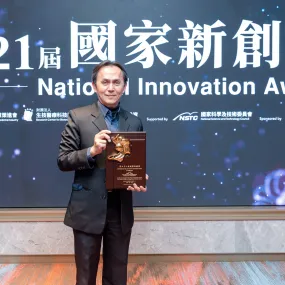
Prof. Guo-bin Jung
Professor, Department of Mechanical Engineering Yuan Ze University
Guo-Bin Jung received his Ph.D. from NTHU in Chemical Engineering Department with research topic about medium-temperature electrolyte synthesis for solid oxide fuel cell (SOFC). In addition to SOFC, he joined the Fuel Cell Center of Yuan Ze University focused on proton exchange membrane fuel cell (PEMFC) studies and serves in Mechanical Engineering Department as a professor. Based on the achievements of PEMFC, he leads a group focused on the generation of low-carbon ozone and negative-carbon hydrogen from water with next-generation proton exchange membrane water electrolysis (NG-PEMWE) - the reversed operation of PEMFC and their potential applications in healthcare, aquaculture, agriculture, food preservation, semiconductor, and energy storage. Purposes of this group is to actively explore the maximum possibility of water with NG-PEMWE for driving industries toward zero-emission.
Theme: Generation of Low-carbon Ozone and Negative-carbon Hydrogen with Next-generation PEMWE Water Electrolysis Leading De-carbonization of Semiconductor Industry
Abstract of Presentation
We believe that water (H2O) is the key dominating de-carbonization in semiconductor manufacturing industry. With our unique next-generation proton exchange membrane water electrolysis (NG-PEMWE) technology, water is one-step dissociated to high-concentration ozone gas mixture (major product, ozone 15~20 vol.%, oxygen 80~85 vol.%) with low-carbon emission, meanwhile high-purity hydrogen is generated with negative-carbon emission as side-product for free. Drive of high concentration ozone and high purity hydrogen in the semiconductor manufacturing market including high pure water (HPW) production, wafer cleaning and waste liquid treatment, and epitaxy, annealing, ion implantation, lithography, respectively. Traditional high concentration ozone production (e.g. corona discharge method) needs pure oxygen pass through high voltage field resulting in high-carbon emission, meanwhile traditional PEMWE generates hydrogen with high cost.
Generated low-carbon and high-concentration ozone from our NG-PEMWE are utilized to efficiently degrade the liquid waste from semiconductor industry. The side-product hydrogen is stored and then can be used in green electricity with proton exchange membrane fuel cell (PEMFC). The achievements of our unique NG-PEMWE assisting green semiconductor manufacturing has been recognized by committee of National Innovation Award (第⼆⼗⼀屆國家新創獎).
Key Technologies Covered
- Generation of low-carbon ozone and negative-carbon hydrogen with next-generation PEMWE
- Degradation of the liquid waste from semiconductor manufacturing with high-conc. ozone efficiently
- Stored hydrogen can be used in green electricity